Next Level Design
The challenging quest for a uniquely Japanese green.
Hand-dyed Green Washi Dial: Design development
Citizen Watch Co. Ltd. (Tokyo) x Watanabe’s (Tokushima)

To mark the 50th anniversary of pioneering light-power technology Eco-Drive, The CITIZEN tasked itself with surveying Japan’s more than one-thousand-year-old culture of dyeing and devising a new, deeper form of colour expression. The result is this hand-dyed green washi dial created by layering indigo over a yellow plant-dye base. We spoke to watch production engineer Daisuke Yamakage and master dyer Kenta Watanabe who jointly oversaw the development process.
Watch the movie
Weaving together two colours
to create a new and distinctive shade.
The esoteric world of plant dye.
Your job title is “watch production engineer.” What does that mean you do?
Yamakage: I’m in charge of development that involves the use of new materials, with a particular focus on watch dials. My job isn’t about turning designs and concepts directly into products, it’s about seeing whether those products can be successfully manufactured at scale while maintaining quality and stability. I’m closer to the frontline than anyone in the planning department, so my approach to watchmaking involves balancing two competing priorities: the desire to make a product versus the hard-nosed reality of whether doing so at a high level is actually practicable.
What sort of ideas did you consider for marking Eco-Drive’s milestone 50th anniversary?
Yamakage: The development of this particular model started from a broad notion of making a special model that would express the distinctiveness of The CITIZEN brand. Washi paper dials are already well-established as part of the brand’s character, and the model originated from people asking whether we could attempt a new form of expression that was a natural evolution from there. Creating a beautiful green dial was one of the proposals that came up, so my job was to figure out what sort of techniques we needed to make a viable product with the requisite quality level. When I embarked on the development of this model, I had to think not just about design issues but also about what was realistically possible.
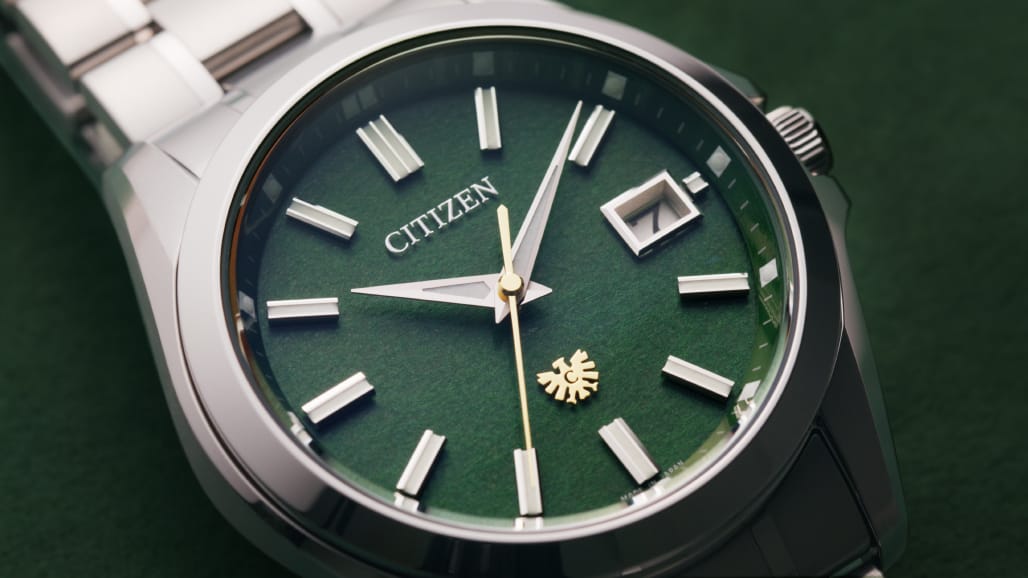
In its combination of light transmittance with a sophisticated aesthetic, this model embodies the technological advances Eco-Drive has made over the last 50 years.
What sort of difficulties did you encounter as the development process got underway?
Yamakage: I discovered that extracting green dye from a single natural ingredient was very difficult. I also found out that Japan has a long history of producing green by combining blue from indigo with yellow from plants. This struck me as a good match for the philosophy of The CITIZEN. Having already developed our hand-dyed indigo washi paper dial models, figuring out the indigo side of things was easy, but I still needed to work out something new: how to create yellow without using chemical dye.
So it all started with a search for a yellow dye?
Yamakage: That’s right. I enlisted Kenta Watanabe of Watanabe’s, the dye workshop we’ve worked with to make our hand-dyed indigo washi paper dials. We started out making samples using dye extracted from lemons and marigolds and experimented with different metal-based mordants for colour fixing. We gradually figured out the direction of travel as we produced more and more samples.
How did you whittle down your dye options?
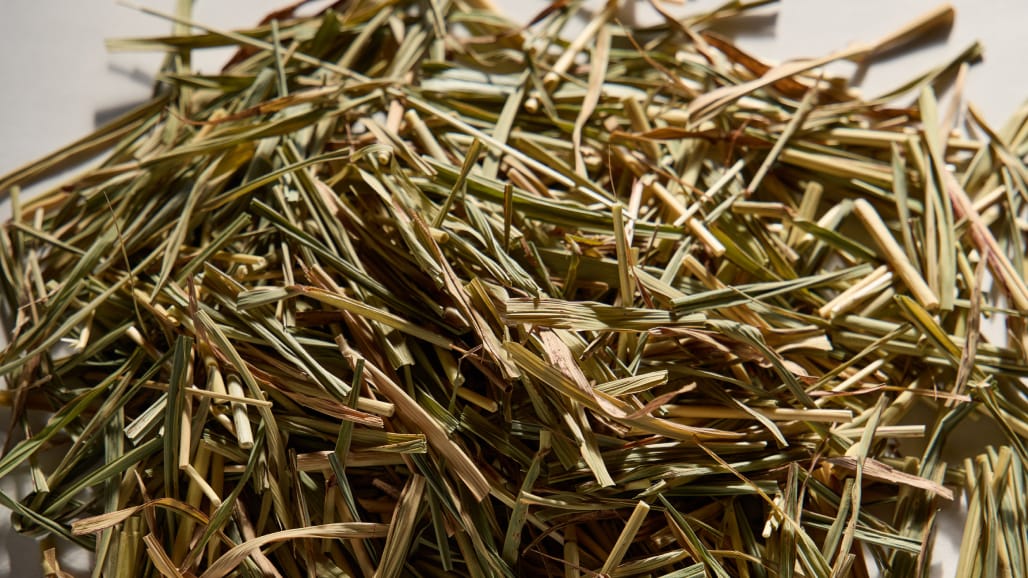
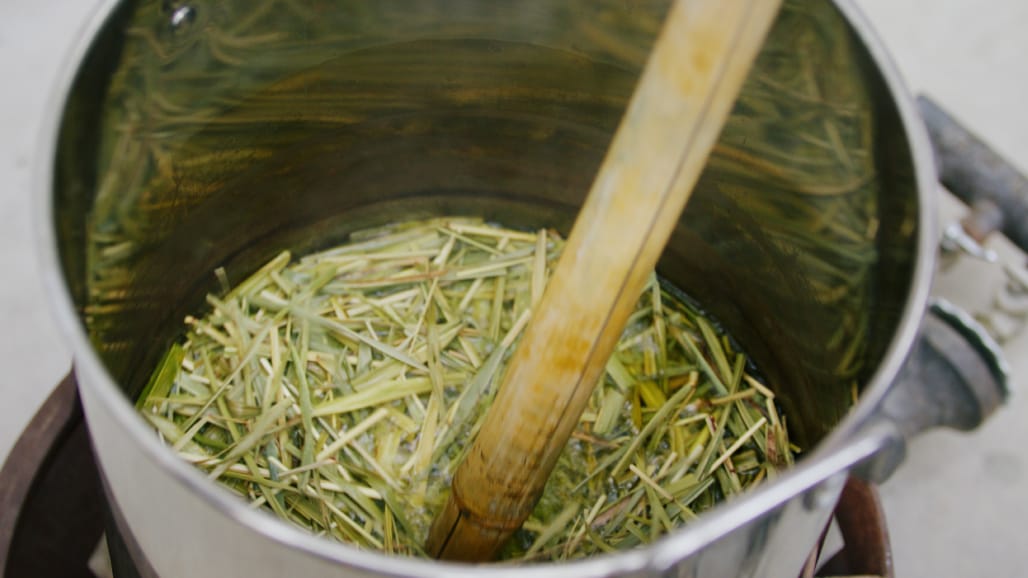
Yamakage: As I researched all the different yellow dyes, I came across kariyasu [Japanese silver grass]. It’s been used for making dye since the Nara period in the eighth century. Further research revealed that Ibuki silver grass—a particular silver grass that grows on Mt. Ibuki, a mountain straddling the Shiga-Gifu prefectural border—is famous for its exceptional quality. Ibuki silver grass has been used for roof thatching and in various traditional crafts for centuries now. On top of that, it was also used to dye washi. All this seemed to make it the perfect fit for a washi paper dial.
Does this Ibuki silver grass still grow in the wild?
Yamakage: It does, yes. Unfortunately, though, Mt. Ibuki’s natural environment is under pressure from things like landslides and deer damage, so harvest volumes are declining. The person who sold us the silver grass we used for our dye is fighting to preserve Mt. Ibuki’s rare plants, and he provided us with this precious silver grass as part of his conservation activities. Ibuki silver grass is a limited natural resource, so we did our best to treat every single stalk with respect in the development process.
I gather you turned to Watanabe’s, with whom you developed your hand-dyed indigo washi dials, to handle the plant dyeing with silver grass?
Yamakage: Yes, we did. Achieving colour consistency when dyeing washi is always difficult, but the fact that Kenta Watanabe and I had already confronted that challenge and so had a shared reservoir of experience was the major factor in my choice. Because we had that foundation to build on, we were confident we could tackle the even harder challenge of using this plant-based dye. Watanabe was open to trying something new and, as we pushed ahead with the project, we thought everything through together. Basically, I asked him to handle both stages of the dyeing for this watch because of the relationship of trust we have.
Searching for a Japanese green
with a dignity worthy of The CITIZEN
What was your reaction when CITIZEN first approached you about making a green washi paper dial using plant-based dye?
Watanabe: After working on hand-dyed indigo washi paper dials for several years, this project seemed like a natural next step. Still, I was like, “wow, it’s really happening.” Personally, I was intrigued by the idea of trying to create a new and distinctive colour by combining indigo with a plant dye. I knew my workshop was up to the job, so I was more gung-ho than apprehensive.
Did you have any experience of dyeing washi with plant-based dye?
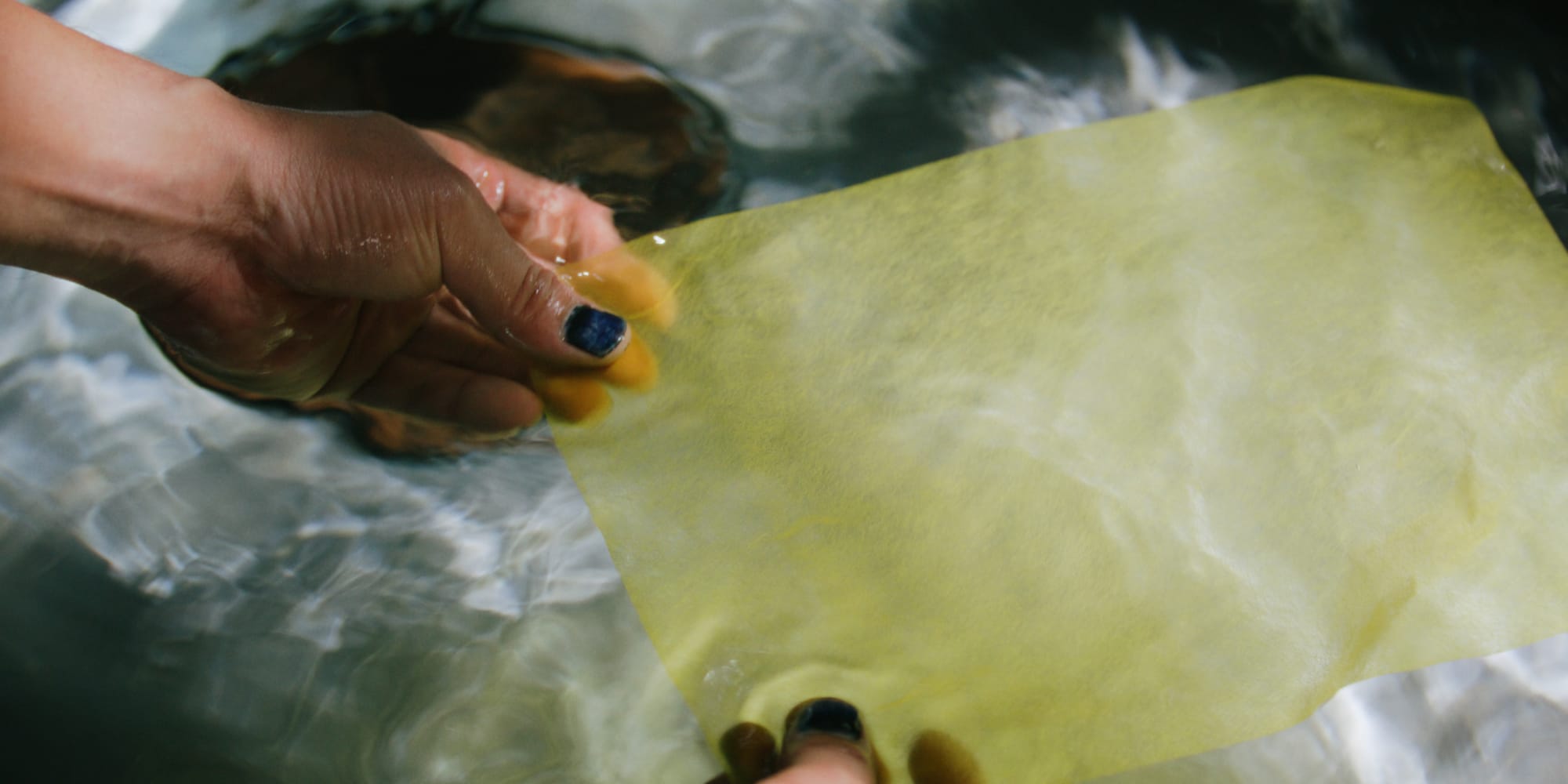
Watanabe: To be honest, at the beginning I didn’t really know what I was doing because I had only used plant-based dyes on fabric before. Tosa washi is a quite different material to fabric, plus it’s extremely thin. The normal approach with plant-based dyes is to dip whatever it is you’re dyeing in a boiled-down dye. How to go about that with washi was the first thing I needed to figure out. I brainstormed with my colleagues and tried out their suggestions. The first step was to make a yellow base colour using plant dye.
What was the first process you tried?
Watanabe: The first thing I needed to figure out in order to produce a vibrant green was how to make the yellow that would be the base colour. I used lemons and marigolds—ingredients it’s easy to get hold of—and I tried about five different mordants to see which combination of dye and mordant worked best.
What is a mordant?
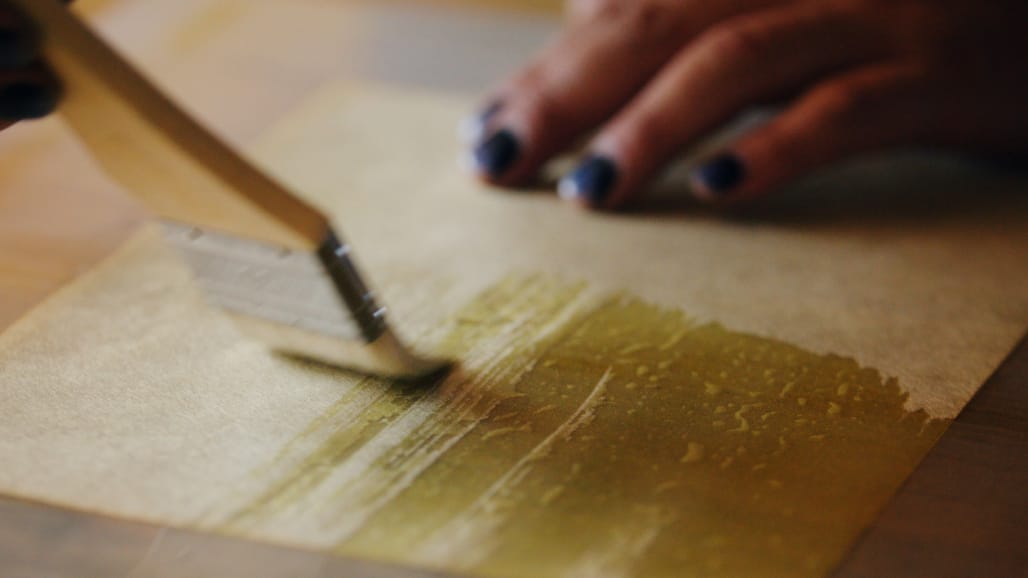
Watanabe: In plant-dyeing, mordants are the metal salts you use to deepen and fix colours through ion exchange. Common mordants include iron, copper, aluminium, titanium and tin, and the same dye can produce a different colour tone depending on the mordant used. Obviously, in this case the mordant had to be compatible with Tosa washi. Copper turned out to be best at bringing out a nice strong yellow.
Was there a difference in the results with marigolds and lemons?
Watanabe: As you’d expect from the colour of the flower, marigolds produce a warm yellow that’s quite close to orange. With lemon, of course, the tone of the yellow is closer to the fruit. It looks lovely, especially when combined with a copper mordant. At that point, I was pretty sure that lemon plus a copper mordant was the winning combination.
While you were busy with that, I gather that the Ibuki silver grass idea actually came from the CITIZEN side?
Watanabe: That’s right. I started experimenting with silver grass from Mt. Ibuki after Yamakage got in touch to say that he wanted me to try it. There’s yellow and there’s yellow. What I mean by that is, when I actually tried silver grass, the colour had a depth to it that was quite different. While the yellow from lemons is light and airy, the yellow from Mt. Ibuki silver grass has real weight and strength. If you mix the two yellows—silver grass yellow and lemon yellow—with the same shade of indigo, the difference is clear for all to see. Mt. Ibuki silver grass produces a green with more dignity, more of an aura about it.
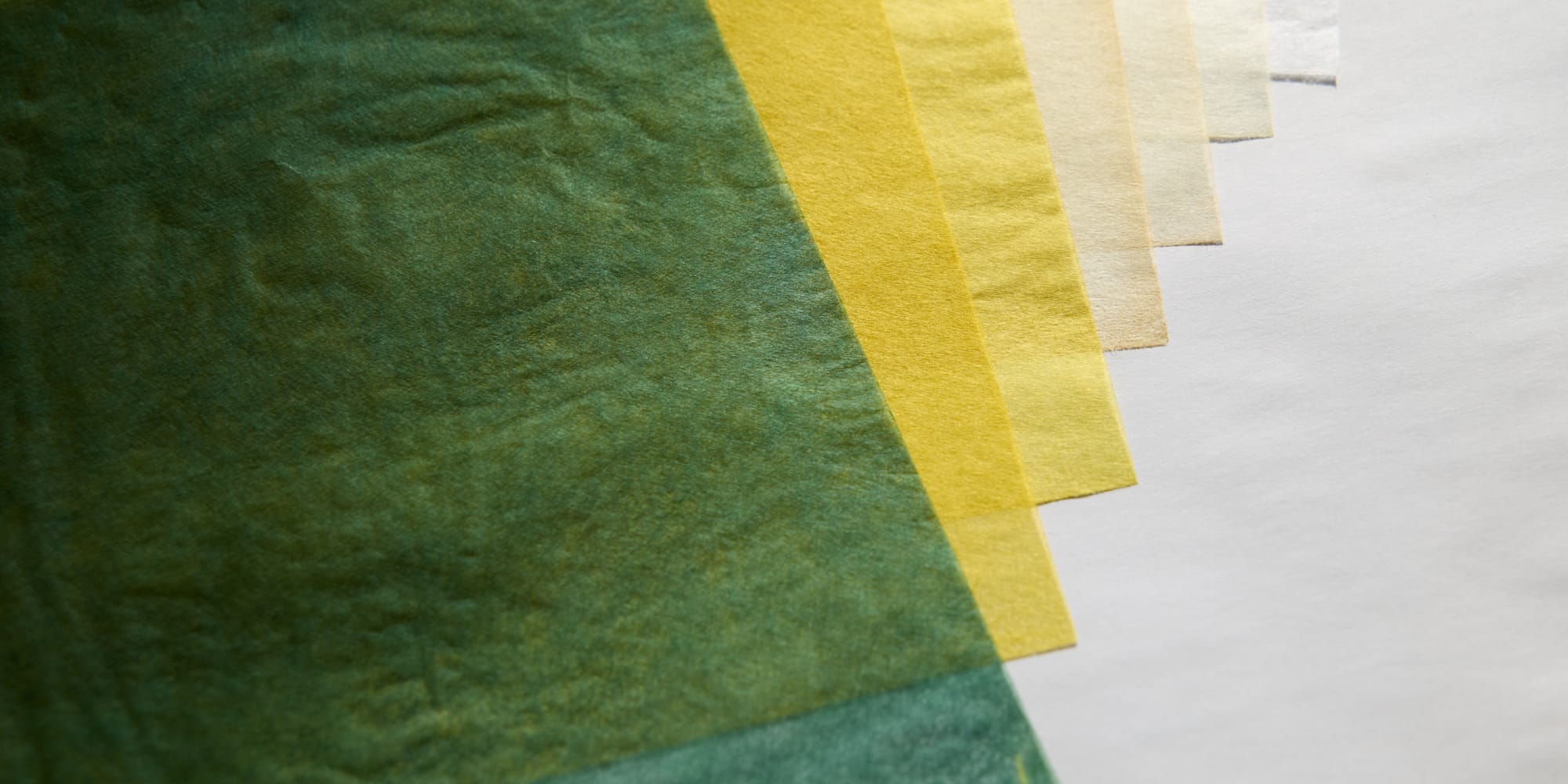
Layering deep indigo over deep yellow
for a green in which the presence of
both constituent colours can be felt.
I hear that making this green dial was harder and more time-consuming than making the indigo dial. Can you talk us through the process?
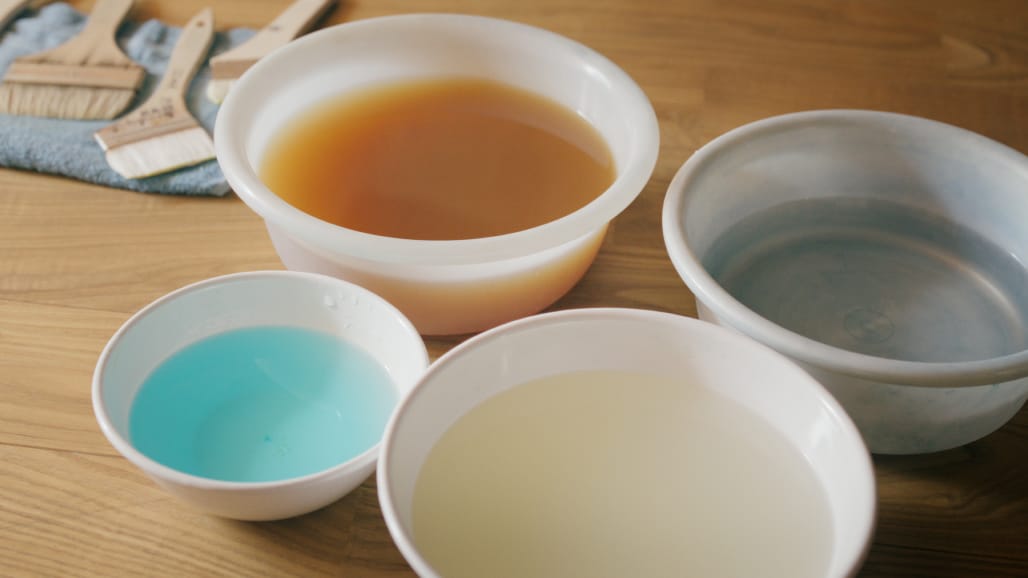
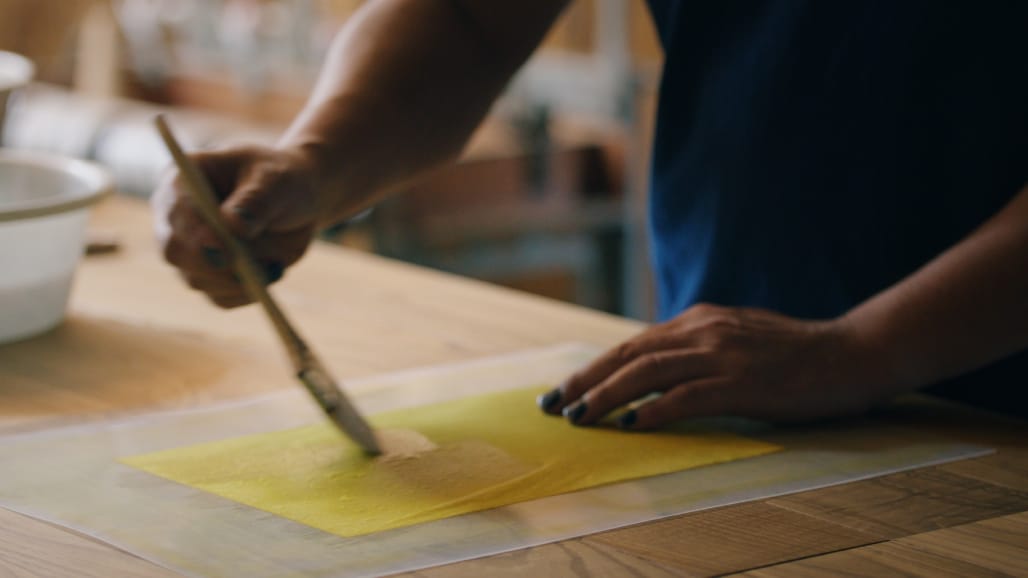
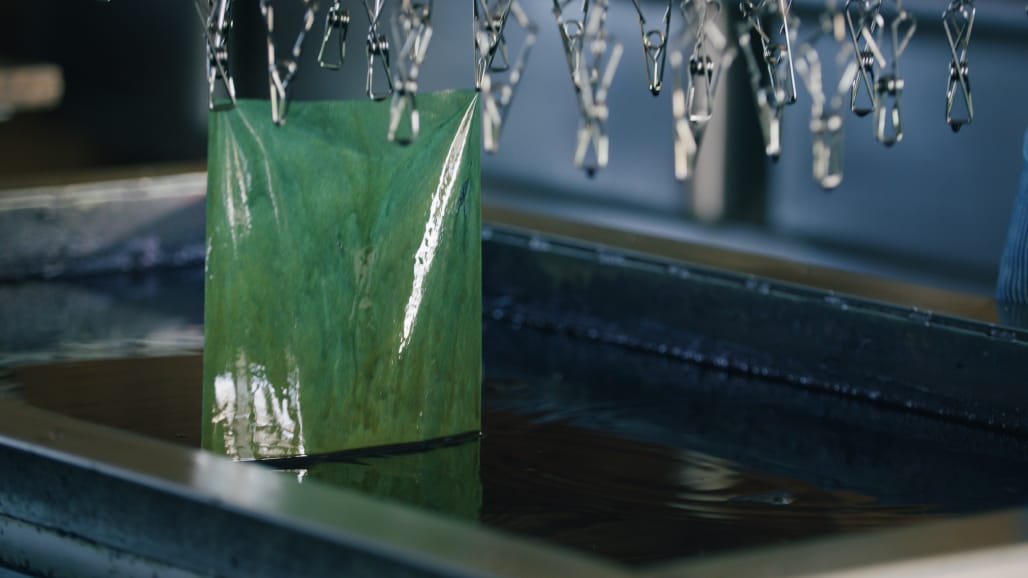
Watanabe: The first thing you do is coat the washi with squeezed soybean juice to ensure that the dye attaches easily to the washi fibres. After drying the washi, you use a large brush to paint it with the silver grass dye liquid you’ve made by boiling down silver grass. You then leave the washi to dry again. You repeat this process several times, while keeping an eye on the colour concentration. Next you use a copper mordant to deepen and fix the yellow, before washing and drying the washi yet again. Once it’s dry, you apply a coat of konjac glue to strengthen the paper for the indigo dyeing process. You then dip it into the indigo several times to dye it. With indigo, the colour fixes automatically in the course of the process. With plant dyes, however, you need to apply repeated coats of dye with a brush and apply the mordant too. Since these are processes I don’t routinely perform, honestly, it was extremely hard work.
Why did you do the silver grass first?
Watanabe: It’s mainly about the difference in colour production. Starting with a good strong yellow from silver grass then layering the indigo on top significantly increases the stability of the final colour. In addition, covering yellow with indigo in the final step makes sense from a durability perspective because indigo is the most lightfast plant dye out there. Those considerations led naturally to the order I followed.
What kind of green were you aiming to create?
Yamakage: The most important thing for me was to create a green that had depth and dovetailed with the horological honesty of The CITIZEN brand. Since Kenta Watanabe was handling the dyeing, I also wanted to keep a sense of indigo’s unique feel in there. I guess I was aiming for a colour poised between the yellow of Ibuki silver grass and the indigo of traditional aizome indigo dyeing.
How long did it take for the two of you to settle on the final colour?
Yamakage: Our thinking on the ideal green gradually converged as we made more samples. All in all, it took over a year.
What was the most difficult part of the actual dyeing?
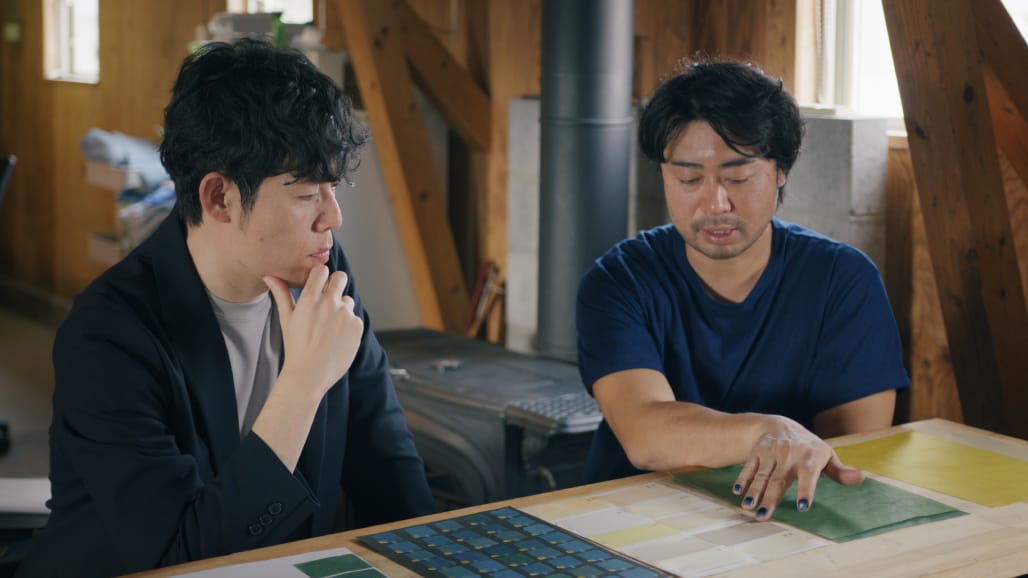
Watanabe: Dealing with inconsistency in the colour was the hardest thing. We dyed this dial first with silver grass and then with indigo, but the colour nuances of the silver grass varied slightly with each lot. Had I been using only indigo, then I could have controlled the colour to some degree, but once you add plant-dyeing to the process, inevitably there are greater fluctuations. I had to examine every single piece of washi and decide how much latitude I was willing to grant and what colour tones were acceptable. It was a very delicate task.
How did the two of you form a shared image of the desired colour?
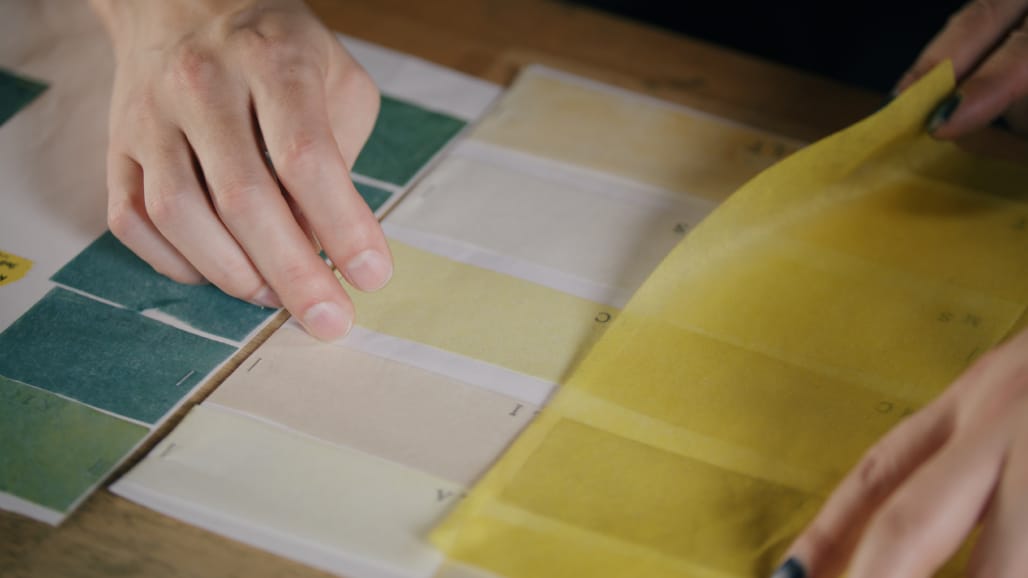
Watanabe: The same green can feel different for different people, so it was crucial for the green that the people at CITIZEN had in mind to match the green that I had in mind. The ideal was a green that simultaneously conveyed the depth of silver grass yellow and the depth of indigo. There was a lot of back-and-forth as we inspected the actual samples. That gradually brought us closer to the “blended green” image that both sides wanted.
I want users to get a sense of the
technical and aesthetic advancements
that Eco-Drive has made.
As you look back at the step up from indigo hand-dyed washi dials to plant-dyed green washi dials, how do you feel about the challenges this model presented?
Watanabe: I could handle the silver grass plant dye for this model precisely because I’d built a solid foundation in washi dyeing from my experience with hand-dyed indigo washi dials. If I’d had to go straight to plant-dyeing without any sort of track record, I’d have fumbled around far more. We managed to develop a form of expression that’s one level higher thanks to the experience I’d built up. It was good timing.
Looking at the finished model, where do you see its appeal?
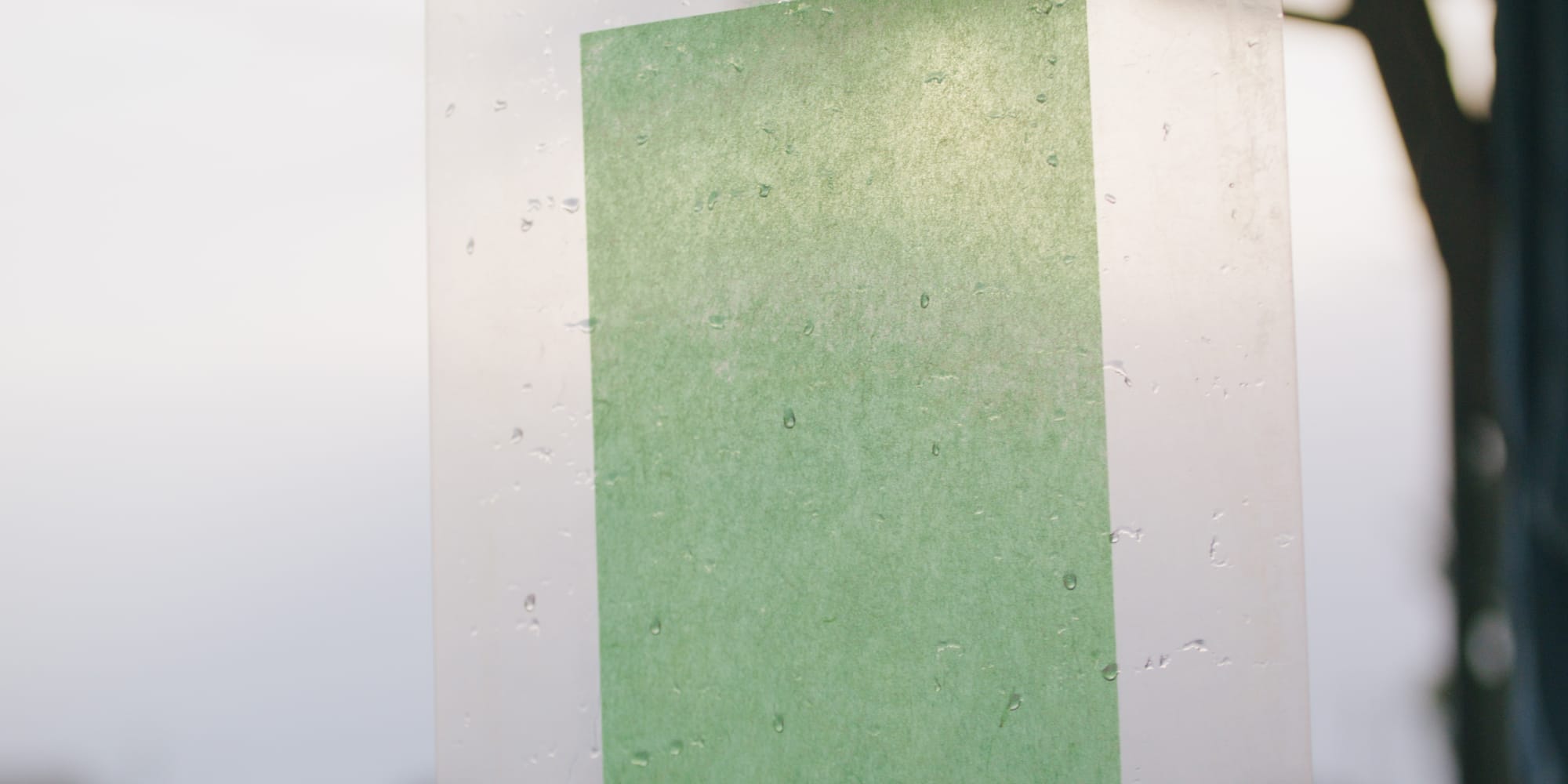
Watanabe: For me, it’s in the ability to feel the deep yellow of Ibuki silver grass and the unique colouration of indigo dye, all at the same time. This is no ordinary blended green; if you look carefully, you can see the two different colours it’s made up of. That depth of colour is the dial’s No. 1 point of appeal in my book. We didn’t just use a plain green, we made one by combining colours derived from carefully chosen ingredients. This model reminded me how much fun it is to do something like that.
Last of all, what would you like to say to people who’ve bought this model?
Watanabe: Because the green of the dial isn’t a solid colour, its depth and expression change according to the viewing angle and the angle of the light. I hope these variations will give our customers a better sense of what can be done with colour. I also hope that they will build up a personal stock of feelings and memories associated with the green colour as they spend time with it. It’d be great if the watch can become meaningful to people in that way.
Yamakage: “At last we’ve attained this level of perfection on Eco-Drive’s milestone 50th anniversary.” That’s how I feel. In the earliest Eco-Drive models, the solar cell which collects light and converts it into power was on top of the dial. Fast forward 50 years and we’ve got to the stage where there’s no visible evidence of the solar cell’s presence whatsoever. And you’ve got the beauty of washi and its different colour expressions added on top of all that accumulated technical know-how. We were only able to create this model because The CITIZEN is as committed to technical and aesthetic advancements as it is to precise time-telling. Everyone perceives colours differently, so I’ll be thrilled if everyone enjoys this model in their own unique way.

About
The hand that makes the washi for the dial…
The hand that inspects the materials…
The hand that sketches the design…
The hand that assembles the watch…
Aspiring to be an integral part of your life.
In the pursuit of the next ideal in timekeeping,
The CITIZEN has a passion for making beautiful things.
The living embodiment of superior craftsmanship,
Our watches pass through a succession of skilled hands
Before reaching their ultimate destination:
the wrists of the wearers.
In Hand to Hand Story,
We highlight all the expert hands,
So dexterous, sensitive and thoughtful,
Required for the complex process of watchmaking.